
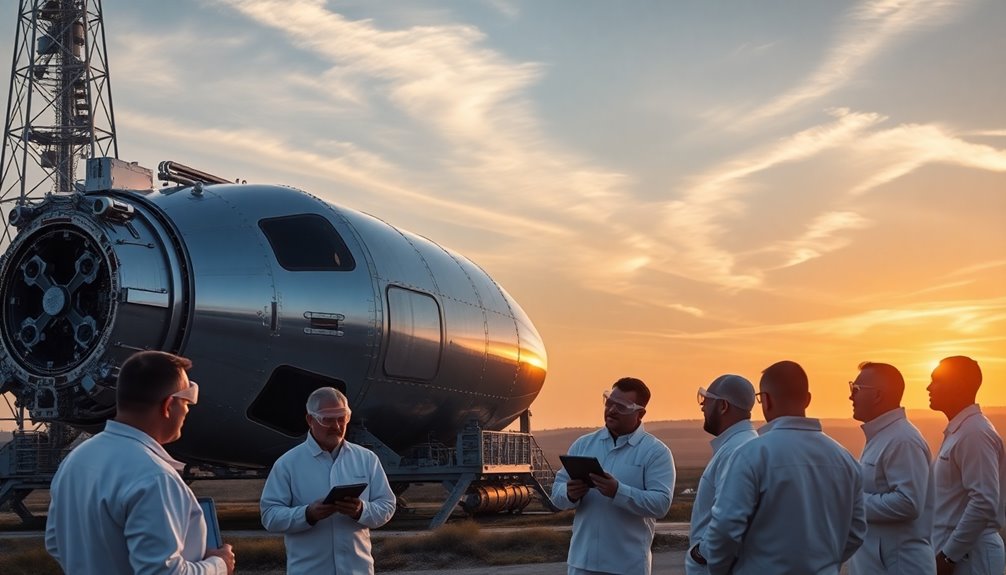
Space technology is pioneering the future of exploration by drastically reducing launch costs through reusable rockets and advanced engine technologies. Private companies like SpaceX and Blue Origin are driving innovation, broadening cosmic horizons, and democratizing access to space. As humanity pushes beyond Earth’s orbit, new resources and knowledge await discovery. From satellite-based research to Mars colonization, the possibilities are vast, and the next breakthroughs are just on the horizon, waiting to be uncovered. In this rapidly evolving landscape, international collaborations are also emerging, enabling countries to share resources and expertise in their quest for new frontiers in the cosmos. Such partnerships will be crucial as we navigate the challenges of living and working in extraterrestrial environments. Ultimately, these developments lay the groundwork for the future of space exploration innovations, promising a new era of human discovery and interstellar understanding.
Reusable Rockets: The Key to Cost-Effective Space Travel
Several decades of space exploration have been hindered by the prohibitively high cost of launching payloads into orbit. This financial burden has stifled progress, limiting the scope and frequency of space missions. Nevertheless, the advent of rocket reusability has transformed the industry, offering a solution to this longstanding problem. By recovering and re-launching rockets, the cost of access to space is considerably reduced. This paradigm shift has enabled organizations to redirect resources for more ambitious projects, rather than exhausting funds on individual launches. Rocket reusability has successfully demonstrated launch cost reduction, paving the way for a new era of space exploration. As the technology continues to evolve, the possibilities for humanity's presence in space will expand, revealing new opportunities for discovery and advancement.
Propelling Humanity Forward: Advanced Engine Technologies
Nearly a century has passed since the inception of modern rocketry, and yet, the fundamental principles of engine design have remained largely unchanged. Nevertheless, recent breakthroughs in advanced engine technologies are revolutionizing space exploration. These innovations are poised to propel humanity forward, enabling faster, more efficient, and sustainable space travel.
Some of the most promising developments include:
- Ion propulsion, which utilizes the energy of electrical energy to accelerate charged particles, resulting in higher thrust efficiency and longer mission durations.
- Plasma thrusters, which utilize electromagnetic fields to ionize and accelerate propellant, achieving high specific impulse and fuel efficiency.
- Advanced nuclear energy sources, providing a reliable and long-lasting energy supply for deep space missions.
- In-orbit assembly and manufacturing, enabling the construction of larger, more complex spacecraft and infrastructure.
The Rise of Private Space Companies
The space industry has witnessed a significant shift with the emergence of private space companies, introducing new players that have disrupted traditional approaches to space exploration. Reusability has been transformed, making space travel more affordable and accessible. As a result, commercializing space travel has become a tangible goal, paving the way for a new era of space exploration.
New Players Emerged
Around 2008, a transformative shift began to take hold in the space technology environment, as private companies started to emerge as significant players. This marked a departure from the traditional dominance of government-led space agencies, paving the way for innovation and global collaboration.
- Emerging startups like SpaceX, Blue Origin, and Virgin Galactic brought new ideas and approaches to space exploration.
- Private investment poured in, driving development and reducing reliance on government funding.
- New players enabled faster immersion and testing, accelerating the pace of progress.
- Global collaboration increased, as companies from diverse regions and industries joined forces to push the boundaries of space technology.
Reusability Revolutionized Space
Private space companies, fueled by innovation and private investment, took a monumental leap forward by prioritizing reusability in their space exploration endeavors. This paradigm shift has enabled the industry to adopt sustainable practices, greatly reducing the environmental footprint of space travel. Reusability has additionally facilitated international collaboration, as companies share knowledge and resources to drive progress. The likes of SpaceX and Blue Origin have spearheaded this revolution, demonstrating the feasibility of reusable launch systems and paving the way for more affordable and efficient space access. As a result, the cost of launching payloads into orbit has decreased, making space exploration more accessible to a broader range of stakeholders.
Commercializing Space Travel
How will humanity capitalize on the reusability revolution that has paved the way for affordable and efficient space access? The rise of private space companies has sparked a new era of commercialization in space travel. This shift is driven by entrepreneurs and innovators who see the vast potential for profit in the cosmos.
- Space tourism is poised to become a lucrative industry, with companies like Virgin Galactic and Blue Origin offering suborbital flights to thrill-seekers.
- Orbital hotels, like the Gateway Foundation's Von Braun Space Station, will cater to the luxury market, providing an unparalleled experience for the wealthy.
- Satellite constellations will provide global internet connectivity, generating billions in revenue.
- In-orbit manufacturing and resource extraction will open up new opportunities for commercial exploitation.
Expanding Our Cosmic Horizons: New Frontiers in Space Exploration
As humanity pushes beyond Earth's orbit, three essential areas of research are emerging to facilitate further exploration: mapping the cosmic highway to identify ideal routes and resource-rich destinations, developing deep space propulsion systems to traverse vast distances efficiently, and constructing planetary outposts to serve as stepping stones for future missions. These advancements will be vital in broadening our presence in the solar system and beyond. By pursuing these new frontiers, scientists and engineers can reveal the mysteries of the cosmos and pave the way for a new era of space exploration.
Cosmic Highway Mapping
Cosmic highway mapping has emerged as a crucial component in the pursuit of broadening our cosmic horizons, enabling the identification of ideal routes for future space exploration missions. This innovative field combines cosmic cartography and gravitational mapping to create a thorough comprehension of the celestial terrain. By charting the intricacies of space, researchers can pinpoint prime routes for spacecraft, reducing travel time and increasing efficiency.
- Gravitational waves are mapped to identify areas with stable gravitational forces, ensuring safe passage for spacecraft.
- Asteroid fields are charted to avoid hazardous collisions and identify potential resources.
- Black holes are studied to grasp their warping effects on space-time, allowing for more accurate navigation.
- Celestial bodies are cataloged to identify potential pit stops for refueling and resupply.
Deep Space Propulsion
Deep Space Propulsion systems are poised to transform the environment of space exploration, building upon the foundation laid by cosmic highway mapping. By utilizing propulsion innovations, humanity is on the cusp of achieving interstellar travel, a feat that will change the pace and scope of cosmic discovery. Next-generation propulsion technologies, such as advanced ion engines and light sails, are being developed to overcome the vast distances between stars. These breakthroughs will enable spacecraft to reach unprecedented speeds, reducing travel times and broadening the boundaries of human exploration. As Deep Space Propulsion systems continue to advance, the possibilities for humanity's cosmic growth will grow exponentially, paving the way for unparalleled discoveries and achievements.
Planetary Outpost Construction
With humanity poised to venture further into the unknown, establishing a sustainable presence beyond Earth becomes a necessity. Planetary outpost construction is essential for broadening our cosmic horizons, enabling humans to thrive in extraterrestrial environments. Key considerations in outpost design include:
- Habitat design that guarantees structural integrity and protection from harsh planetary conditions
- Life support systems capable of sustaining human life for extended periods
- In-situ resource utilization to minimize reliance on Earth-based supplies
- Modular architecture that allows for scalability and adaptability as needs evolve
The Democratization of Space Travel
As private enterprise and government agencies push the boundaries of space travel, a significant shift is taking place: the democratization of space travel is becoming a tangible reality. This paradigm shift is fueled by the pursuit of affordable access to space, allowing a broader range of individuals to participate in space exploration. No longer is space travel exclusive to highly trained astronauts; citizen astronauts are now emerging as a new class of space travelers. Private companies like SpaceX and Blue Origin are pioneering this movement, offering commercial spaceflight opportunities to those who can afford it. As the cost of access to space decreases, the door is opening for a diverse range of individuals to experience the thrill of space exploration, sparking a new era of exploration and discovery.
Earthly Applications of Space Technology
Many of the technological innovations born from the pursuit of space exploration have found their way back to Earth, yielding a plethora of practical applications that improve daily life. These innovations have far-reaching implications, transforming various aspects of modern society.
Some of the significant earthly applications of space technology include:
- Satellite communication, enabling global connectivity and high-speed data transmission
- Earth observation, providing critical insights for environmental monitoring, disaster response, and climate research
- Agricultural innovation, leveraging space-born technologies to boost crop yields and optimize resource allocation
- Urban planning and transportation efficiency, using space-derived data to design smarter, more sustainable cities
Unleashing the Power of Space-Based Research
Space-based research has opened doors to unprecedented scientific discoveries, catalyzing breakthroughs in our grasp of the universe and its mysteries. By utilizing the unique advantages of space, scientists can conduct experiments and gather data unencumbered by Earth's limitations. For instance, space-based agriculture enables the study of plant growth in microgravity, yielding insights into crop yields and potential applications for sustainable food production. In addition, satellite internet facilitates rapid data transmission, connecting researchers worldwide and encouraging collaborative breakthroughs. The vast, unobstructed view of the cosmos from space likewise allows for unparalleled astronomical observations, driving advances in our comprehension of the universe. As the scope of space-based research expands, humanity stands to reap unprecedented rewards, from revolutionary technologies to profound new insights into the nature of existence itself.
Charting a Course for Mars and Beyond
Humanity's next great leap forward in space exploration is unfolding, with Mars and the distant reaches of the solar system beckoning. As the next frontier, Mars colonization is becoming a tangible reality, with private companies and governments alike investing heavily in the endeavor. Nevertheless, the challenges involved in interplanetary communication, transportation, and habitation are significant.
To overcome these hurdles, space agencies and companies are developing innovative solutions, including:
- Advanced propulsion systems capable of faster travel times
- In-orbit assembly and manufacturing of spacecraft and habitats
- Artificial gravity through rotating sections of spacecraft
- High-gain antennas and laser communication systems for reliable data transmission
Frequently Asked Questions
Can Space Technology Be Used to Monitor and Prevent Natural Disasters?
As the earth trembles and skies darken, the veil of uncertainty lifts, revealing a glimmer of hope. Space technology stands poised to unravel the mysteries of natural disasters, wielding the strength of satellite monitoring to predict the unpredictable. By utilizing the precision of disaster prediction, the world can prepare for the fury of nature, mitigating devastation and saving countless lives. With space technology at the forefront, the future of disaster response is rewritten, enabling humanity to confront the forces of nature with unyielding determination.
How Does Space Exploration Benefit Daily Life on Earth?
In the pursuit of advancing human civilization, space exploration has yielded tangible benefits for daily life on Earth. Health advancements have been catalyzed by space research, leading to improved medical technology and telemedicine capabilities. Furthermore, communication improvements have enabled seamless global connectivity, facilitating international collaboration and commerce. These dividends of space exploration have empowered humanity, elevating the quality of life and nurturing a more interconnected world.
What Are the Potential Risks of Space Travel for Humans?
In the vast expanse of space, a fragile vessel carries humanity's greatest aspirations, yet conceals sinister threats. The astronauts, pioneers of the cosmos, are susceptible to radiation exposure, a silent assassin that corrodes their bodies. As they venture further, the psychological effects of isolation and confinement begin to manifest, like a slow-burning fire that consumes their minds.
Can We Use Space Technology to Solve Earth's Energy Crisis?
As the world grapples with the looming energy crisis, a solution may lie beyond Earth's atmosphere. Space technology can be utilized to capture solar energy on a massive scale, beaming it back to the planet as a clean and sustainable energy source. Additionally, space-based research has driven innovations in energy efficiency, which can be applied to terrestrial systems. By adopting these space-borne solutions, humanity can fuel its future without compromising the planet's resources.
Will Humans Ever Establish Permanent Settlements on the Moon?
Establishing permanent human settlements on the moon is a tantalizing prospect. To achieve this, lunar agriculture will be essential, providing a reliable food source for inhabitants. Habitat sustainability will likewise be key, as self-sufficient infrastructure will need to be developed to support life on the harsh lunar surface. As technological advancements continue to propel humanity forward, the possibility of lunar colonization becomes increasingly viable, beckoning a new era of intergalactic dominion.