
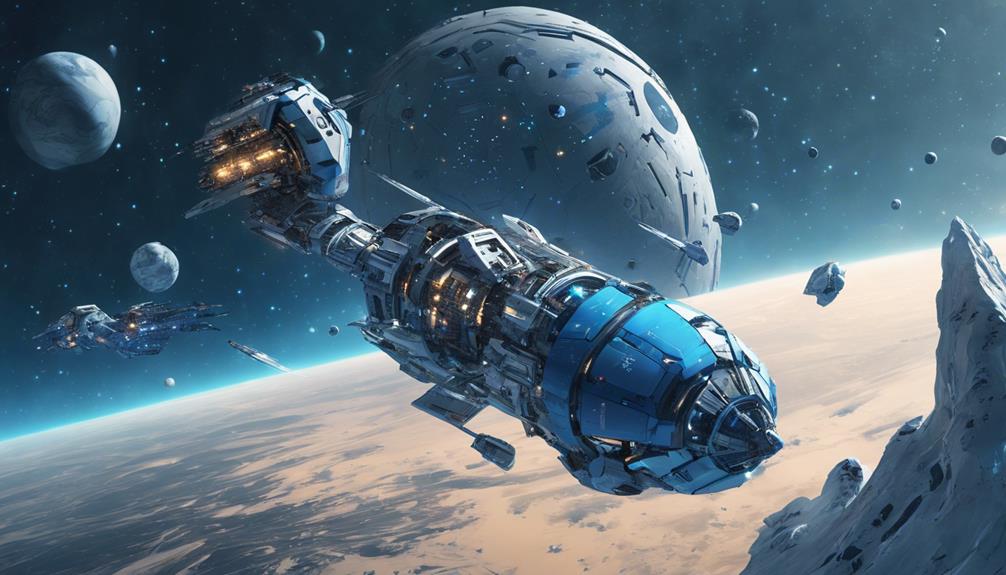
The future of space exploration is poised for a major transformation, driven by a plethora of groundbreaking technologies. Advanced propulsion systems, such as plasma propulsion and warp drives, are being developed to enable faster and more efficient travel. AI-powered spacecraft will navigate through uncharted territories, optimize fuel consumption, and respond to unexpected events autonomously. Virtual reality training will simulate real-world scenarios, whilst 3D-printed space habitats and space-based solar energy capturing will sustain humans in space. Quantum computing, in-orbit manufacturing, reusable rockets, and nanotechnology will further accelerate progress. As these innovations unfold, the possibilities for space exploration will become increasingly limitless, revealing new frontiers yet to be explored.
Advanced Propulsion Systems Emerge
As the space industry continues to push the boundaries of interstellar travel, a new generation of advanced propulsion systems is emerging, promising to transform the way humans explore and interact with the cosmos. Among these innovations, plasma propulsion is gaining significant attention for its potential to transform space travel. By utilizing the energy of ionized gases, plasma propulsion systems can achieve faster acceleration and more efficient fuel consumption, enabling spacecraft to traverse vast distances in a shorter timeframe.
Another promising concept is the warp drive, a hypothetical method of faster-than-light travel proposed by physicist Miguel Alcubierre in 1994. Even though still largely theoretical, warp drives could potentially allow spacecraft to reach distant star systems in a matter of weeks or months, rather than decades or centuries. Despite significant scientific and engineering hurdles that must be overcome before warp drives can become a reality, ongoing research and development are bringing us closer to making this concept a tangible possibility.
These advanced propulsion systems hold the key to revealing the secrets of the universe, enabling humanity to explore and settle the vast expanse of space. As research and development continue to progress, we can expect to see significant breakthroughs in the coming decades, paving the way for a new era of space exploration and discovery.
AI-Powered Spacecraft Take Flight
As AI-fueled spacecraft take flight, they bring with them a trifecta of transformative technologies that are poised to modernize space exploration. At the forefront of this transformation are autonomous navigation systems, intelligent data analysis tools, and improved decision-making capabilities, each designed to optimize spacecraft performance and enable unprecedented levels of efficiency and precision. By utilizing the potential of artificial intelligence, these systems will empower spacecraft to operate with greater independence, making them better equipped to tackle the intricate challenges of deep space exploration. Moreover, the integration of these advanced technologies not only enhances mission success rates but also reduces the need for constant human oversight, allowing for more ambitious and prolonged missions. However, as we embrace these innovations, it is essential to consider the autonomous vehicles benefits and challenges, examining the risks associated with reliance on AI and the need for rigorous fail-safes. By addressing these concerns, we can ensure a balanced approach to integrating autonomous systems in the quest to unlock the mysteries of the universe.
Autonomous Navigation Systems
Currently, a significant paradigm shift is underway in space exploration, with AI-powered spacecraft increasingly relying on autonomous guidance systems to chart their courses and make critical decisions without human intervention. This shift marks a significant departure from traditional spacecraft operations, where human controllers played a central role in piloting and controlling the spacecraft.
Autonomous guidance systems employ AI-driven navigation, enabling robotic explorers to adapt to changing environments and make decisions in real-time. This capability has far-reaching implications for space exploration, as it allows spacecraft to:
- Autonomously pilot through uncharted territories, reducing the need for human intervention.
- Optimize fuel consumption, resulting in extended mission durations and reduced costs.
- Respond to unexpected events, such as asteroid encounters or system failures, without human input.
- Conduct complex maneuvers, like docking and landing, with precision and accuracy.
Intelligent Data Analysis Tools
The integration of autonomous navigation systems with advanced data analysis tools is revolutionizing space exploration, enabling AI-driven spacecraft to navigate through uncharted territories and extract valuable insights from the vast amounts of data they collect. As spacecraft venture further into the cosmos, they generate enormous amounts of data, which can be overwhelming for human analysts to process. This is where intelligent data analysis tools come into play. By leveraging AI algorithms, these tools can sift through the data, identify patterns, and provide actionable insights.
Data visualization techniques are also essential in this process, as they enable researchers to convert complex data into intuitive and easily interpretable formats. This facilitates a deeper comprehension of the data, allowing scientists to make new discoveries and draw meaningful conclusions. For instance, AI-driven data analysis tools can help identify anomalies in celestial bodies, detect exoplanets, or uncover hidden patterns in space weather. By tapping into the potential of intelligent data analysis, space agencies and researchers can reveal the mysteries of the universe, propelling human knowledge and comprehension forward.
Enhanced Decision-Making Capabilities
AI-powered spacecraft, equipped with advanced decision-making algorithms, are poised to transform space exploration by autonomously adapting to unforeseen circumstances and making data-driven decisions in real-time. This improved decision-making capability enables spacecraft to respond quickly to unexpected events, such as changes in weather patterns or system malfunctions, ensuring mission success and crew safety.
The integration of cognitive computing and strategic planning in AI-powered spacecraft enables them to:
- Examine vast amounts of data in real-time to identify patterns and make informed decisions.
- Autonomously adjust mission parameters to optimize resource allocation and minimize risks.
- Simulate scenarios to predict outcomes and prepare for potential challenges.
- Learn from experiences and adapt to new situations, refining decision-making processes over time.
Virtual Reality Training Evolves
Beyond the boundaries of traditional instruction, virtual reality training is transforming the way space agencies prepare astronauts for the harsh environment of space. This state-of-the-art technology allows trainees to immerse themselves in simulated environments that replicate the extreme conditions they will encounter during space missions. By wearing VR headsets, astronauts can engage in immersive experiences that replicate spacewalks, emergency scenarios, and other crucial situations.
The benefits of VR training are manifold. For one, it reduces the risks associated with traditional training methods, which often involve expensive and intricate equipment. Moreover, VR training enables astronauts to repeat exercises multiple times, refining their skills and developing muscle memory. This level of repetition would be impractical or even impossible in real-world settings.
Furthermore, VR training provides a level of precision and control that is challenging to achieve in physical environments. Instructors can customize simulations to specific scenarios, allowing astronauts to practice and perfect their responses to a wide range of situations. This targeted approach enables space agencies to optimize their training programs, ensuring that astronauts are better prepared to handle the challenges of space travel. As VR technology continues to evolve, it is likely to play an increasingly significant role in the training of astronauts, ultimately contributing to the success of future space missions.
3D-Printed Space Habitats Rise
Quickly advancing additive manufacturing technologies are paving the way for the creation of durable, functional, and sustainable space habitats, revolutionizing the concept of space exploration and habitation. 3D printed habitats are becoming a reality, offering a promising solution to the challenges of space architecture and design.
The benefits of 3D printed habitats are numerous. For one, they can be designed to be highly sustainable, using local materials and minimizing waste. This is particularly important in space exploration, where resources are limited and waste management is a significant concern.
Here are some key advantages of 3D printed habitats:
- In-situ resource utilization: 3D printing technology can use local materials, reducing the need for resupply missions and minimizing waste.
- Customizability: 3D printed habitats can be customized to specific mission requirements, providing tailored living spaces for astronauts.
- Scalability: 3D printing allows for the creation of habitats of varying sizes, from small modules to large structures.
- Rapid deployment: 3D printed habitats can be quickly assembled, reducing the time and effort required for habitat construction.
As space agencies and private companies continue to push the boundaries of space exploration, the development of 3D printed habitats is poised to play a critical role in the future of space habitation. By addressing the design challenges of space architecture, 3D printed habitats can provide sustainable, functional, and durable living spaces for astronauts, paving the way for extended stays in space.
Space-Based Solar Energy Harnessed
As the world shifts to renewable energy sources, space-based solar energy tapping emerges as a promising solution to meet growing global demand. This innovative approach involves deploying satellites and orbiting platforms to capture and convert the Sun's energy into a usable form. The key to accessing this potential lies in the development of efficient energy harvesting methods, reliable satellite energy transmission systems, and sustainable orbiting energy platforms.
Energy Harvesting Methods
Approximately 1366 watts of solar energy per square meter of solar panel surface area are available in Earth's orbit, making space-based solar energy harvesting a promising method for energizing future space exploration missions. This abundant energy source can energize spacecraft, satellites, and even lunar or planetary bases. In addition to solar panels, other energy harvesting methods are being explored, including:
- Wind turbines: Deployed in the upper atmosphere or on other planets, wind turbines can generate electricity from wind currents.
- Nuclear reactors: Compact, lightweight nuclear reactors can provide a reliable source of energy for long-duration space missions.
- Thermophotonic cells: These cells convert heat into electricity, making them suitable for tapping energy from planetary bodies or asteroids.
- Radioisotope thermoelectric generators: These devices convert the heat generated by radioactive decay into electricity, providing a long-lasting energy source for space missions.
Satellite Power Transmission
One promising application of space-based solar energy capturing is satellite energy transmission, which enables the collection of solar energy in orbit and its subsequent beaming back to Earth or other planetary surfaces. This innovative approach leverages the advantages of space-based solar energy harvesting, where the sun's energy is more consistent and intense than on Earth's surface. Satellite energy transmission technology utilizes advanced photovoltaic cells to convert sunlight into electricity, which is then transmitted wirelessly back to Earth or other destinations via microwave beams or laser links. This wireless transmission method guarantees energy efficiency, as it eliminates the need for lengthy energy transmission lines and reduces energy losses during transmission. Moreover, satellite energy transmission can provide a clean and sustainable source of energy, contributing to a reduced carbon footprint and mitigating climate change. With ongoing advancements in this technology, satellite energy transmission is poised to play a significant role in the future of space exploration and global energy production.
Orbiting Energy Platforms
Orbiting energy platforms, designed to capture the immense energy of space-based solar energy, offer a promising solution for beaming clean and sustainable energy back to Earth or other planetary surfaces. By utilizing the potential of the sun in orbit, these platforms can provide a constant and reliable source of energy, unaffected by the limitations of traditional renewable energy sources.
The benefits of orbiting energy platforms are numerous:
- Continuous energy supply: Solar satellites can collect energy 24/7, without interruptions from weather or nighttime.
- Zero emissions: Orbital energy generation produces no greenhouse gas emissions or pollution.
- Global energy distribution: Energy can be beamed to any location on the planet, providing energy access to remote or underserved areas.
- Scalability: Orbiting energy platforms can be easily adjusted up or down to meet growing energy demands.
Quantum Computing in Space
NASA's ambitious plans to utilize the potential of quantum computing in space could transform the way scientists process vast amounts of data generated by space exploration missions. By utilizing the potential of quantum computing, researchers can expedite intricate calculations, enabling them to scrutinize massive datasets more efficiently and accurately. This groundbreaking technology has the potential to transform space travel by facilitating real-time data processing, which is essential for deep space missions where communication delays are substantial.
In space, quantum computing can optimize resource allocation, enhance navigation, and improve decision-making. For example, quantum computers can swiftly process vast amounts of data from astronomical observations, allowing scientists to spot patterns and make new discoveries. Furthermore, quantum computing can boost the precision of space weather forecasting, enabling more dependable space travel and reducing the risk of radiation exposure to both humans and electronic systems.
The integration of quantum computing in space exploration will further empower scientists to tackle intricate problems, such as simulating the behavior of black holes or comprehending the origins of the universe. As NASA continues to push the boundaries of space travel, the application of quantum computing will be pivotal in unveiling new insights and propelling innovation. By embracing this state-of-the-art technology, humanity can take a significant leap forward in its quest to explore and comprehend the vast expanse of space.
In-Orbit Manufacturing Advances
As the space industry continues to rely on innovative technologies like quantum computing, another transformative development is unfolding in the form of in-orbit manufacturing, which enables the production of critical components and materials in the microgravity environment of space. This emerging capability is poised to transform the way we approach space exploration and habitation.
In-orbit manufacturing offers several advantages over traditional Earth-based production methods. For instance, the microgravity environment allows for the creation of unique materials with novel properties, such as fiber optics and crystals. Furthermore, in-orbit manufacturing enables:
- Material recycling: Recycling materials in space reduces waste and conserves resources, making long-duration space missions more sustainable.
- 3D printing techniques: In-orbit 3D printing enables the rapid production of spare parts, tools, and other crucial items on demand.
- On-demand production: In-orbit manufacturing enables the production of critical components and materials as needed, reducing the need for resupply missions from Earth.
- Enhanced research capabilities: In-orbit manufacturing facilitates the creation of complex scientific instruments and experiments, enhancing our knowledge of the universe.
Reusable Rockets Revolutionize
A new era of cost-effective entry to space has dawned with the arrival of reusable rockets, which are transforming the operational paradigm of the space industry. This innovative approach has notably reduced the financial burden of launching payloads into orbit, making space travel more accessible and affordable. Reusable rockets have paved the way for frequent and reliable missions, enabling the space industry to accelerate its pace of exploration and discovery.
One of the key benefits of reusable rockets is the ability to recover and refurbish them after each launch, significantly reducing production costs. Rocket refurbishment involves inspecting, repairing, and reconfiguring the rocket's components to ensure they meet the required standards for the next mission. This process not only saves time and resources but enables the rockets to be launched multiple times, further reducing the cost per launch.
The impact of reusable rockets on the space industry has been profound. With the ability to launch payloads more frequently and at a lower cost, the industry can now focus on more ambitious projects, such as establishing a human settlement on the moon or sending missions to Mars. The reduced cost of access to space has also opened up new opportunities for commercial satellite operators, enabling them to launch more satellites and expand their services. As the technology continues to evolve, reusable rockets are poised to play a crucial role in shaping the future of space exploration.
Nanotechnology in Space Exploration
Several breakthroughs in nanotechnology are poised to transform the space industry, enabling the development of lighter, stronger, and more efficient spacecraft and equipment. This innovative technology has the potential to change space exploration by providing novel materials and solutions that can withstand the harsh conditions of space.
One of the most significant advantages of nanotechnology in space exploration is its ability to reduce the weight of spacecraft and equipment. This can lead to significant fuel savings, increased payload capacity, and extended mission durations. Moreover, nanotech applications can improve the durability and resistance of materials to extreme temperatures, radiation, and other environmental stressors.
Some potential applications of nanotechnology in space exploration include:
- Advanced thermal protection systems: Nanomaterials can provide improved insulation and heat resistance, reducing the need for bulky thermal protection systems.
- Stronger and lighter materials: Nanotechnology can create materials with boosted mechanical properties, such as strength and stiffness, while reducing their weight.
- Self-healing materials: Nanomaterials can be designed to self-repair, reducing the need for maintenance and repair in space.
- Advanced life support systems: Nanotechnology can enhance air and water purification systems, enabling sustainable space habitats.
The potential of nanotechnology to transform space exploration is vast, and its applications will be crucial in the development of sustainable space habitats and long-duration missions. As research and development progress, we can expect to see significant advancements in the field, paving the way for humanity's next monumental leap into space.
Frequently Asked Questions
How Will Space Exploration Affect the Environment Back on Earth?
As humanity ventures further into space, it is crucial to assess the environmental impact of our pursuits. The extraction of resources, launch emissions, and potential contamination of celestial bodies all pose risks to the ecosystem. To mitigate these effects, conservation efforts must be integrated into space exploration strategies. By adopting sustainable practices and investing in eco-friendly technologies, we can minimize the harm inflicted on our planet and guarantee a responsible pursuit of space discovery.
Can Space-Based Telescopes Replace Those on Earth's Surface?
Like celestial sentinels, telescopes have long gazed up at the starry expanse, unraveling the universe's secrets. Now, the question arises: can space-based telescopes supplant those on Earth's surface? The answer lies in technological advancements. Space-based telescopes, free from atmospheric interference, can observe the cosmos with unparalleled clarity. Their observational capabilities far surpass those of their terrestrial counterparts, offering a sharper, more precise vision of the universe. As technology continues to advance, the case for space-based telescopes grows stronger, poised to transform our insight of the cosmos.
Will Space Tourism Lead to Overcrowding in Earth's Orbit?
As space tourism gains momentum, concerns about overcrowding in Earth's orbit are growing. The increasing number of satellites and spacecraft in orbit raises questions about orbital sustainability. Unregulated space traffic could lead to collisions, debris, and communication disruptions. To mitigate these risks, it is crucial to establish clear guidelines and regulations for responsible space operations, ensuring that the benefits of space tourism are balanced with the need to preserve a safe and sustainable orbital environment.
Can Space Exploration Help Solve Global Energy Crises?
As the world teeters on the brink of an energy crisis, a solution may lie beyond our planet. Space exploration can reveal the mysteries to a sustainable future. Renewable energy harvested from space, such as satellite strength, could supplement our dwindling resources. Space mining for rare earth metals can facilitate the development of advanced energy storage systems. The possibilities are endless, and it's time to venture into the unknown to secure a brighter tomorrow.
Will Humans Eventually Become a Multi-Planetary Species?
The prospect of humans becoming a multi-planetary species is a tantalizing one. Interplanetary colonization, though still largely theoretical, has the potential to guarantee the long-term survival of humanity. As technology advancements continue to propel us forward, the possibility of establishing self-sustaining colonies on other planets becomes increasingly feasible. With ongoing innovations in propulsion systems, life support systems, and habitat construction, the stars may soon be within our reach, offering a safeguard against global catastrophes and securing our species' future.