
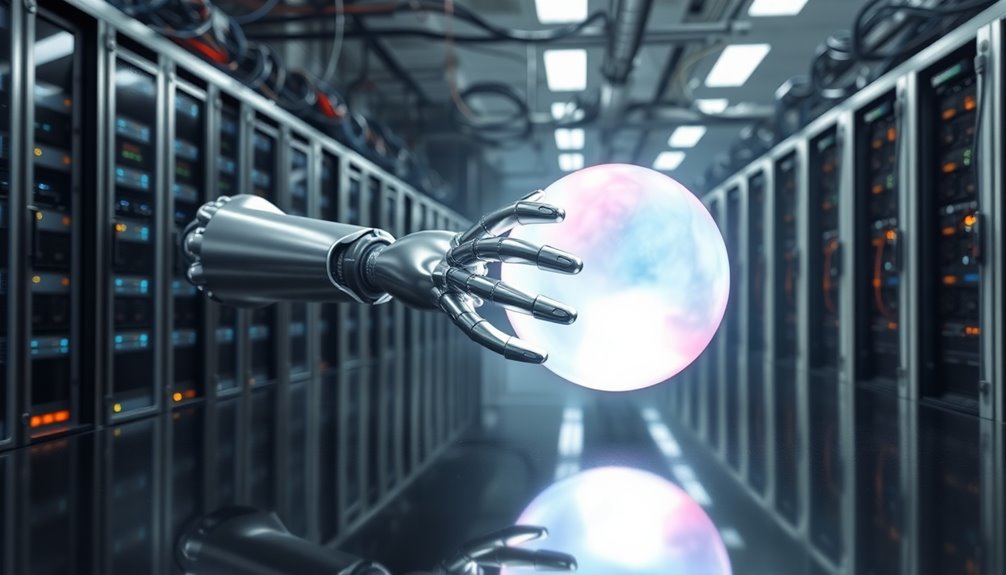
Artificial intelligence is transforming the world at an unprecedented pace, revolutionizing industries and economies through automation and data-driven decision making. Autonomous systems are streamlining healthcare, manufacturing, and transportation, simultaneously raising complex ethical concerns about accountability and transparency. As AI redefines the future of work, humans must adapt to leverage its capabilities and mitigate its risks. As AI's impact expands, comprehending its intricacies and challenges becomes essential to utilizing its transformative strength and shaping a responsible future.
Revolutionizing Industries and Economies
As artificial intelligence continues to advance, it is poised to transform industries and economies in unprecedented ways. One area where AI is already making a significant impact is in supply chain automation. By leveraging machine learning algorithms and real-time data, companies can optimize their logistics, reducing costs and increasing efficiency. AI-powered systems can predict demand, manage inventory, and streamline transportation, resulting in faster and more reliable delivery of goods. Furthermore, AI-driven financial forecasting is revolutionizing the way businesses approach financial planning. With the ability to analyze vast amounts of data, AI systems can identify trends, predict market fluctuations, and provide accurate forecasts, enabling companies to make informed decisions and stay ahead of the competition. As AI continues to evolve, its potential to reshape the industrial and economic terrain is vast and unparalleled.
The Rise of Autonomous Systems
With the advent of artificial intelligence, autonomous systems are emerging as a transformative force, poised to innovate the way we live and work. Autonomous vehicles, for instance, are revolutionizing transportation, promising increased efficiency, reduced accidents, and improved mobility for the elderly and disabled. Smart robotics is another area where autonomous systems are making a significant impact, streamlining manufacturing processes, and boosting productivity. These systems can operate 24/7, reducing labor costs and minimizing errors. As autonomous systems continue to advance, they will increasingly assume complex tasks, freeing humans to focus on higher-value tasks that require creativity, empathy, and problem-solving skills. The rise of autonomous systems heralds a new era of unprecedented efficiency, productivity, and innovation, transforming the fabric of our society and economy. Moreover, the role of robotics in work is set to expand even further as we integrate these technologies into various sectors, including healthcare, agriculture, and logistics. In these fields, robots can assist with repetitive tasks, allowing human workers to dedicate their skills to more complex and nuanced aspects of their jobs. As we embrace this technological shift, it will be crucial to address challenges such as workforce displacement and the need for reskilling, ensuring that the benefits of autonomous systems are shared widely across society.
AI and the Future of Work
The advent of artificial intelligence is poised to reshape the workforce in profound ways, forcing a reevaluation of traditional employment structures and the roles humans play within them. As AI assumes tasks formerly relegated to humans, the very nature of work is being redefined.
- AI-powered automation will augment human capabilities, freeing professionals to focus on high-value tasks that require creativity, empathy, and strategic thinking.
- Remote collaboration will become the norm, as AI facilitates seamless communication and project management across geographically dispersed teams.
- The need for continuous skill evolution will become paramount, as workers must adapt to an ever-changing environment of technological advancements.
- AI-driven analytics will enable data-driven decision-making, rendering intuition-based leadership obsolete.
- The gig economy will continue to expand, with AI matching workers with projects that align with their unique skill sets and interests.
The Ethics of Creating Autonomous Beings
Beyond the domain of workforce disruption, the development of autonomous beings raises profound ethical questions about the responsibilities that come with creating conscious entities. The moral implications of creating autonomous beings with their own agency and decision-making capabilities cannot be overstated. As these entities begin to take on increasingly complex tasks, the question of autonomous rights and their place within our society becomes increasingly pressing. Establishing ethical frameworks for the development and deployment of autonomous beings is vital, particularly in regards to responsibility assignment. Who is accountable when an autonomous being makes a mistake or causes harm? The assignment of responsibility will have far-reaching consequences, shaping the future of human-autonomous being interactions and the moral fabric of our society. As the creators of these conscious entities, humans must grapple with the weight of responsibility and develop a framework that balances innovation with accountability.
Unleashing Human Potential With AI
As autonomous beings assume increasingly complex tasks, humans are freed from mundane and repetitive responsibilities, enabling them to focus on higher-value pursuits that stimulate creativity, innovation, and personal growth.
By releasing human potential with AI, individuals can:
- Empower creativity: AI-generated ideas and insights can spark new perspectives and approaches, nurturing novel solutions and innovations.
- Enhance decision making: AI-driven analytics can provide accurate and timely data, enabling humans to make informed, data-driven decisions.
- Amplify productivity: Automation of routine tasks can increase efficiency, allowing humans to allocate more time and resources to high-impact activities.
- Encourage collaboration: AI-facilitated communication can bridge language and cultural gaps, facilitating global cooperation and knowledge sharing.
- Pursue lifelong learning: AI-powered educational platforms can offer personalized, adaptive learning experiences, helping humans acquire new skills and stay ahead in a swiftly changing world.
AI-Driven Innovation in Healthcare
AI-driven innovation in healthcare is poised to transform the industry by enabling personalized medical treatment customized to individual patients' unique needs and characteristics. Advanced algorithms can analyze vast amounts of medical data to identify patterns and correlations, leading to improved disease diagnosis accuracy and more effective treatment outcomes. As AI continues to advance, it is likely to open new possibilities for precision medicine and change the way healthcare providers approach patient care.
Personalized Medical Treatment
Personalized medical treatment has long been the holy grail of healthcare, where customized therapies and interventions can be crafted to individual patients' unique genetic profiles, medical histories, and lifestyle factors. AI-driven precision medicine is revolutionizing this field by enabling the analysis of vast amounts of genomic data, medical records, and real-time health metrics. This allows for the creation of bespoke treatment plans that maximize efficacy and minimize side effects.
- AI-assisted genetic profiling enables the identification of high-risk patients and targeted interventions
- Machine learning algorithms optimize treatment regimens based on real-time patient data
- Personalized medicine reduces healthcare costs by minimizing ineffective treatments
- AI-driven analysis of medical literature and clinical trials accelerates discovery of new treatments
- Integration of AI with electronic health records (EHRs) streamlines clinical workflows
Disease Diagnosis Accuracy
Nearly 80% of medical diagnoses are influenced by a doctor's interpretation of patient data, making accurate diagnosis a crucial aspect of healthcare. Artificial intelligence is revolutionizing disease diagnosis accuracy by leveraging machine learning algorithms and predictive analytics tools. These technologies enable healthcare professionals to analyze vast amounts of patient data, identifying patterns and anomalies that may indicate specific diseases. AI-driven diagnosis systems can process medical images, lab results, and patient histories with unprecedented speed and precision, reducing the likelihood of human error. As a result, healthcare providers can deliver more accurate diagnoses, leading to targeted treatments and improved patient outcomes. By augmenting human judgment with AI-powered insights, the future of disease diagnosis looks increasingly precise and effective.
Building Transparent and Accountable AI
Frequently, the development of AI systems raises questions about their decision-making processes and potential biases. As AI becomes increasingly pervasive, it is crucial to establish transparent and accountable systems that can explain their actions and justify their decisions.
To achieve this, experts are working on developing:
- AI transparency frameworks that provide insights into AI decision-making processes
- Accountability in algorithms to guarantee fairness and prevent biases
- Explainable AI that can provide clear explanations for its actions
- Human oversight mechanisms to detect and correct errors
- Regulatory frameworks that hold developers and users accountable for AI systems' actions
Navigating the Uncharted Territory of AI
As AI continues to advance and permeate various aspects of life, it is venturing into uncharted territories, where the rules and norms are still being written. This uncharted territory is fraught with challenges, as AI's rapid growth outpaces the development of regulations and standards. One of the primary concerns is data privacy, as AI systems increasingly rely on vast amounts of personal data to function. Additionally, algorithm bias poses a significant threat, as AI systems can perpetuate and amplify existing social inequalities. Maneuvering through this uncharted territory requires a nuanced comprehension of AI's capabilities and limitations, along with a commitment to developing ethical frameworks that prioritize transparency, accountability, and fairness. By acknowledging the intricacies and challenges of AI, we can work towards utilizing its transformative influence while mitigating its potential risks.
Frequently Asked Questions
Can AI Systems Be Creative and Come up With Original Ideas?
Like a master painter's brushstroke, AI's creative potential is unfolding. Can AI systems conjure original ideas? The answer lies in their capacity for artistic expression, where algorithms dance with data to produce novel solutions. AI's innovative problem-solving prowess is already evident, birthing groundbreaking discoveries in fields like medicine and astronomy. As AI's cognitive faculties continue to evolve, the boundaries of creativity will be pushed, and the possibilities will be endless, limited only by the scope of human imagination.
Will AI Surpass Human Intelligence in the Near Future?
The prospect of artificial intelligence surpassing human intelligence in the near future is a pressing concern. Rapid machine learning advancements have accelerated AI's capabilities, but ethical implications loom large. As AI inches closer to human-level intelligence, questions arise about accountability, responsibility, and potential consequences. Will humanity be able to wield AI's influence without relinquishing control? The answer remains uncertain, but one thing is clear: the trajectory of AI development will have far-reaching consequences for humanity's future.
Can AI Be Used to Enhance Human Emotional Intelligence?
Like a master weaver, AI can intertwine with human emotions, strengthening the fabric of emotional intelligence. By leveraging emotional analytics, AI can pinpoint areas of improvement, providing personalized coaching to augment empathy and self-awareness. As AI empathy evolves, it can become a trusted confidant, helping individuals navigate intricate social dynamics and make informed decisions. This potent fusion can unseal new levels of emotional intelligence, empowering individuals to navigate the intricacies of human relationships with precision and finesse.
How Will AI Change the Way We Learn and Educate?
The traditional classroom paradigm is on the cusp of a radical shift. AI-driven personalized learning will transform the education environment, tailoring curricula to individual students' needs and learning styles. Virtual classrooms will emerge, allowing for immersive, interactive experiences that transcend geographical boundaries. As AI optimizes the learning process, students will absorb knowledge at an unprecedented pace, propelling them in the direction of unparalleled success.
Will AI Systems Be Able to Experience Emotions Like Humans?
The prospect of AI systems experiencing emotions like humans raises intriguing questions. Currently, emotional algorithms are being developed to mimic human-like responses, but can they truly replicate the complexity of human empathy? As AI may excel in simulating emotional intelligence, it remains to be seen whether it can genuinely feel emotions. As AI systems continue to evolve, the line between artificial and authentic emotional experiences will likely become increasingly blurred.