
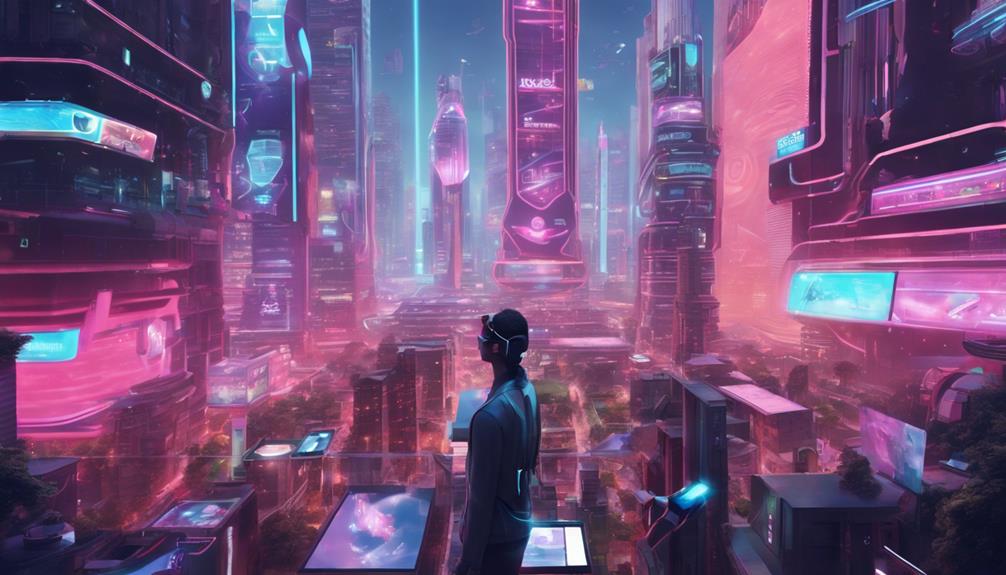
Augmented reality (AR) seamlessly blends the digital and physical worlds, superimposing virtual information onto real-world environments to create immersive, interactive, and transformative experiences. By overlaying digital objects onto real-world surroundings, AR has the potential to transform industries such as marketing, education, healthcare, and retail. From enhancing gaming experiences to transforming medical training and retail shopping, AR's applications are vast and varied. As this technology continues to evolve, it's clear that its impact will be felt across multiple facets of our lives, and exploring its possibilities will reveal even more innovative and unexpected uses.
What Is Augmented Reality?
Augmented reality (AR) is a technology that is increasingly being used to blend the digital and physical worlds, superimposing virtual information and objects onto real-world environments. This innovative technology has far-reaching implications for various industries, from commerce to education. In the domain of marketing, AR applications are being leveraged to create immersive and engaging experiences for customers, allowing them to interact with products in entirely new ways. For instance, virtual try-on capabilities and product demonstrations are becoming increasingly popular, enabling customers to make more informed purchasing decisions.
As AR development continues to advance, future possibilities for this technology seem endless. With the ability to enrich our physical surroundings with digital information, AR has the potential to transform the way we live, work, and communicate. From remote training and education to improved gaming experiences, the potential applications of AR are vast and varied. Furthermore, as AR technology becomes more accessible and affordable, we can expect to see widespread adoption across industries. As businesses and individuals alike begin to utilize the potential of AR, it will be exciting to see the innovative marketing strategies that emerge, and the ways in which this technology will shape our collective future.
A Brief History of AR
As we explore the world of augmented reality, it is crucial to understand its roots and development over time. The concept of AR has undergone significant transformations, from its early inception to its modern applications. This brief history will examine the key milestones, including early AR concepts, pioneering work in the 1960s, and the emergence of modern AR technologies.
Early AR Concepts
In the 1960s, computer scientist Ivan Sutherland pioneered the concept of augmented reality with his innovative work on virtual reality head-mounted displays. This groundbreaking research laid the foundation for early AR concepts, which would later evolve into more sophisticated AR experiments and applications.
Early AR Concepts | Description | Key Features
———|————-|————-
Sutherland's Head-Mounted Display | First AR prototype | Virtual reality, head-tracking
Myron Krueger's Videoplace | Early AR experiment | Interactive, immersive environment
Micro-optical Mechanical (MOM) | Early AR display technology | High-resolution, see-through display
ARToolkit | Open-source AR software | Marker-based tracking, flexible development
These early AR concepts and prototypes paved the way for further research and development in the field, driving innovation and advancements in AR technology. They demonstrated the potential of AR to enrich our interactions with the physical world and to create new, immersive experiences. By exploring these early AR concepts, we can gain a deeper insight into the evolution of AR and its future possibilities.
AR in the 60s
The 1960s marked a significant milestone in the development of augmented reality, with pioneers like Ivan Sutherland and Myron Krueger laying the groundwork for what would become a transformative technology. During this era, AR technology began to take shape, driven by innovations in computer graphics, display systems, and sensor technologies. Ivan Sutherland's 1968 thesis, 'Sketchpad,' is often cited as one of the first AR-like systems, allowing users to interact with virtual objects in 3D space.
Myron Krueger's 'Videoplace' system, developed in the late 1960s, used video cameras and projectors to create an immersive AR environment. These early experiments demonstrated the potential of AR to merge the physical and digital worlds. The 60s innovations paved the way for future AR developments, showcasing the technology's potential to enrich human-computer interaction, education, and entertainment. Despite still in its infancy, the AR concept had begun to materialize, setting the stage for further advancements in the decades to come.
Modern AR Emerges
Modern AR Emerges
Fast-forwarding to the 1980s and 1990s, the contemporary augmented reality era began to take shape, driven by advancements in computer capacity, software, and display technologies. This period witnessed the development of virtual reality (VR) and augmented reality (AR) technologies, paving the way for innovative applications across various industries.
| Industry | AR Applications |
|---|---|
| Marketing | AR marketing trends, Virtual product demonstrations |
| Fashion | AR fashion experiences, Virtual fittings |
| Sports | AR in sports, Improved stadium experiences |
| Travel | AR travel applications, Virtual sightseeing guides |
| Education | Interactive learning experiences, Virtual laboratories |
As computer graphics and display technologies improved, AR started to gain traction in various fields. The 1990s saw the emergence of AR in sports, with the introduction of virtual graphics and real-time data overlays during live broadcasts. The fashion industry also began to explore AR, enabling customers to try on virtual clothing and accessories. With the internet becoming more widespread, AR marketing trends started to take shape, allowing brands to engage with customers in immersive and interactive ways. As AR technology continues to evolve, its applications are expected to expand, transforming the way we live, work, and interact with the world around us.
How Augmented Reality Works
Through a seamless fusion of digital information and real-world environments, augmented reality technology overlays virtual objects, sounds, or other sensory inputs onto the physical space. This innovative technology aims to improve the user experience by offering interactive and immersive experiences. In AR applications, the user's surroundings blend with the experience, blurring the lines between the physical and digital worlds.
The AR hardware, consisting of devices like smart glasses, smartphones, and tablets, plays a vital role in enabling this experience. These devices come with sensors, cameras, and displays that allow the software to monitor the user's environment and overlay virtual objects in real-time. The software development process includes developing algorithms that can accurately recognize and monitor the user's surroundings, while also generating high-quality virtual objects and sounds.
The combination of AR hardware and software development allows for the creation of advanced AR applications that can be utilized in various industries, such as education, healthcare, and entertainment. By offering users interactive and captivating experiences, AR technology has the potential to transform the way we learn, work, and engage with each other. As the technology advances, we can anticipate seeing even more innovative AR applications that will shape the future of human-computer interaction.
AR in the Gaming Industry
The gaming industry has witnessed a significant transformation with the integration of augmented reality (AR) technology. By superimposing virtual objects onto real-world environments, AR enables the creation of immersive gaming experiences that blur the lines between physical and digital worlds. Moreover, AR boosts gameplay mechanics, allowing for innovative interactions and fresh ways to engage with virtual content.
Immersive Gaming Experiences
Frequently, gamers have been seeking more immersive and engaging experiences, and augmented reality (AR) has emerged as a promising technology to transform the gaming industry. By incorporating AR, games can now offer interactive storytelling, allowing players to engage with virtual characters and environments in a more dynamic way. Virtual tours, for instance, can transport players to new worlds, providing an unparalleled sense of presence and exploration.
Moreover, AR enables real-time interactions, allowing gamers to engage with each other in entirely new ways. Social experiences, such as collaborative puzzle-solving or competitive multiplayer games, can be taken to the next level with AR. Players can interact with each other's avatars, share virtual objects, or even participate in AR-enhanced esports events. The possibilities are endless, and the gaming industry is only just beginning to scratch the surface of what AR can do. As AR technology continues to evolve, we can expect to see even more innovative and immersive gaming experiences emerge.
Enhanced Gameplay Mechanics
By seamlessly blending digital information with real-world environments, augmented reality is redefining traditional gameplay mechanics, revealing new possibilities for interactivity and depth in the gaming industry. This fusion enables the creation of innovative gameplay elements, such as interactive challenges that encourage players to engage with their surroundings in novel ways. For instance, AR-powered games can task players with completing puzzles that incorporate real-world objects or environments, nurturing a sense of immersion and connection to the game world.
Moreover, AR enables the integration of virtual rewards into real-world environments, allowing players to access exclusive content or bonuses by completing specific tasks or achieving certain milestones. This strategic gameplay approach leverages real-world integration to create a more dynamic and responsive gaming experience. By incorporating elements of the physical world into gameplay, AR games can encourage players to explore their surroundings, interact with others, and develop new skills. As the technology continues to evolve, we can expect to see even more innovative applications of AR in the gaming industry, further blurring the lines between the physical and digital worlds.
Revolutionizing Education With AR
Augmented reality is transforming the education environment by providing immersive, interactive, and engaging learning experiences that captivate students' attention and improve their grasp of complex concepts. By incorporating AR technology into the classroom, educators can increase student engagement and nurture a deeper comprehension of subject matter. Interactive learning experiences, such as 3D models and simulations, enable students to explore and interact with virtual objects in a hands-on manner, making complex concepts more accessible and memorable.
Virtual field trips are another way AR is revolutionizing education. Students can explore historical sites, museums, and other places of interest remotely, eliminating logistical barriers and increasing accessibility. This interactive and immersive approach to learning allows students to develop a more nuanced comprehension of historical events, cultural contexts, and scientific concepts. Hands-on experiences, such as virtual dissections and experiments, enable students to explore complex concepts in a safe and controlled environment, reducing the risk of accidents and promoting a deeper grasp of scientific principles. By leveraging the capability of AR, educators can create a more engaging, interactive, and effective learning environment that prepares students for success in the 21st century.
Healthcare and Augmented Reality
Beyond the classroom, the impact of augmented reality is being felt in the healthcare sector, where its applications are revolutionizing the way medical professionals train, diagnose, and treat patients. One significant area of impact is medical training, where AR is being used to create immersive and realistic surgical simulations. These simulations enable medical students and professionals to practice complex surgical procedures in a safe and controlled environment, reducing the risk of errors and improving overall competence.
In addition to medical training, AR is transforming patient care. Virtual consultations, enabled by AR, allow patients to remotely connect with healthcare professionals, reducing the need for in-person visits and wait times. This is particularly beneficial for patients with mobility issues or those living in remote areas with limited access to healthcare facilities. AR-powered virtual consultations also enable healthcare professionals to remotely monitor patients' conditions, providing timely interventions and improving health outcomes.
Furthermore, AR is being used to enrich patient education and engagement. By providing interactive, 3D visualizations of the human body, AR enables patients to better understand their conditions and treatment options, leading to more informed decision-making and improved adherence to treatment plans. As the healthcare sector continues to evolve, the potential applications of AR are vast, and its impact on patient care and medical training is likely to be profound.
The Rise of AR in Retail
Retailers are harnessing the power of augmented reality to recreate the shopping experience, bridging the gap between online and offline channels. By integrating AR technology into their strategies, retailers can create immersive and interactive shopping experiences that captivate customers and drive sales. For example, AR product visualization enables customers to see how products would look in their own spaces before making a purchase, reducing the likelihood of returns and increasing customer satisfaction.
Here are three key ways AR is transforming the retail realm:
- Enhanced product demonstrations: AR allows customers to interact with products in 3D, providing a deeper grasp of features and benefits.
- Virtual try-on technology: Customers can try on virtual clothes, makeup, or accessories, reducing the need for physical try-ons and increasing conversions.
- Personalized customer engagement: AR-powered chatbots and virtual assistants can offer tailored recommendations and styling advice, nurturing a more intimate and engaging shopping experience.
AR in Architecture and Design
As the boundaries between physical and digital spaces continue to blur, architects and designers are tapping into the potential of augmented reality to reimagine the built environment and transform the design process. AR is changing the way architects and designers work, allowing them to create immersive and interactive 3D models that can be shared with clients and stakeholders. This enables a more collaborative and efficient design process, reducing the risk of miscommunication and errors.
In interior design, AR is being used to visualize and customize spaces before they are built. Clients can use AR apps to see how furniture, lighting, and other design elements would appear in a space, making it easier to make informed decisions. This technology also enables designers to create unique designs that are customized to a client's specific needs and preferences.
AR is also being applied in urban planning, allowing city planners to visualize and analyze complex urban systems. By overlaying digital information onto real-world environments, AR can help planners identify areas of inefficiency and optimize urban design. For instance, AR can be used to simulate traffic flow, pedestrian movement, and energy consumption, enabling planners to create more sustainable and livable cities. As AR technology continues to progress, it is likely to have a significant impact on the built environment, enabling architects and designers to create spaces that are more functional, sustainable, and aesthetically pleasing.
Augmented Reality in Daily Life
As we explore the domain of Augmented Reality, it becomes increasingly evident that its applications extend far beyond specialized industries, permeating various aspects of our daily lives. From enhancing educational experiences to revolutionizing the retail environment, AR is poised to transform the way we learn, shop, and interact with the world around us. This section will examine the transformative potential of AR in two key areas: education and retail.
AR in Education
Nearly 70% of students report increased engagement and motivation when interactive augmented reality experiences are integrated into their learning environment. This is due to AR's ability to transform traditional learning methods into immersive, interactive, and engaging experiences. AR enriches student engagement by providing a hands-on approach to learning, making complex concepts more accessible and enjoyable to learn.
Here are three ways AR is revolutionizing education:
- Interactive learning: AR enables students to interact with 3D models, videos, and other multimedia content, making learning more captivating and effective.
- Virtual field trips: AR allows students to explore historical sites, museums, and other places virtually, offering a unique and immersive learning experience.
- Hands-on experiences: AR provides students with the opportunity to conduct experiments, simulations, and other hands-on activities in a safe and controlled environment, fostering experiential learning.
AR in Retail
Frequently, customers have been seeking more immersive and engaging shopping experiences, and augmented reality has been responding to this demand by transforming the retail industry in various ways. AR has enabled interactive shopping experiences, allowing customers to explore products in 3D, visualize how furniture would look in their home, and even virtually try on clothing and accessories. Virtual try-ons have become increasingly popular, eliminating the need for physical fitting rooms and reducing returns. Retailers can use AR to provide customers with detailed product information, tutorials, and demonstrations, enhancing their overall shopping experience. Additionally, AR has enabled retailers to create engaging in-store experiences, such as virtual product demos and interactive displays. By incorporating AR into their strategies, retailers can increase customer satisfaction, reduce costs, and stay ahead of the competition. As AR technology continues to evolve, we can expect to see even more innovative applications in the retail industry, revolutionizing the way we shop and interact with products.
The Future of AR Technology
Beyond the current applications of AR technology, innovators are already envisioning a future where augmented reality seamlessly integrates into daily life, transforming the way we interact, work, and play. As the technology continues to advance, we can expect to see significant transformations in various industries. With the rise of augmented reality in everyday life, routines such as shopping, learning, and even social interactions will be enhanced by interactive and immersive experiences. For instance, consumers could virtually try on clothes or visualize furniture in their home before making a purchase, while students might explore historical events through realistic simulations. As developers unleash the potential of this technology, the boundaries between the digital and physical worlds will blur, opening up new possibilities for creativity and productivity.
In the domain of entertainment, AR is poised to overhaul the way we experience movies, video games, and live events. Envision being able to step into a virtual world, where the boundaries between reality and fantasy blur. With AR, this vision is becoming increasingly achievable.
In the transportation sector, AR is anticipated to enhance safety, efficiency, and navigation. For example, AR-powered glasses could offer drivers with real-time traffic updates, navigation instructions, and safety alerts.
Here are three key areas where AR is projected to have a significant impact in the future:
- Enhanced storytelling: AR will empower creators to craft immersive, interactive stories that engage audiences in entirely fresh ways.
- Smart infrastructure: AR will be integrated into urban planning, enabling cities to become more efficient, sustainable, and responsive to citizens' needs.
- Remote collaboration: AR will facilitate seamless collaboration and communication among remote teams, bridging the gap between physical and virtual workspaces.
As AR technology continues to progress, we can anticipate widespread adoption across industries, leading to transformative changes in the way we live, work, and interact with each other.
AR and Virtual Reality Compared
As I delve into immersive technologies, I'm often asked to differentiate between augmented reality (AR) and virtual reality (VR), two terms that are frequently used interchangeably, yet possess distinct characteristics that set them apart. While both technologies alter our perception of reality, the main difference lies in the level of immersion and interaction with the environment. Virtual reality creates a completely artificial setting that isolates from the physical world, while augmented reality overlays digital information onto the actual environment, enhancing our perception of it.
The technological variances between AR and VR are significant. VR necessitates a headset or device that blocks out the physical surroundings, whereas AR can be experienced through a smartphone, tablet, or specialized glasses. This fundamental difference in design has a profound impact on the types of applications each technology facilitates. AR applications, like Pokémon Go, have a tangible impact on reality, prompting users to interact with their environment in innovative ways. On the other hand, VR is commonly used for gaming, simulation, and training purposes, where complete immersion is vital.
Grasping the distinction between AR and VR is vital for leveraging their potential. By acknowledging their unique strengths and limitations, we can develop specific applications that utilize the advantages of each technology. As we continue to explore the realm of augmented reality, it's vital to recognize the nuances that differentiate it from its virtual counterpart. By doing so, we can fully utilize the potential of AR and foster meaningful innovation in various industries.
Overcoming AR Adoption Challenges
In spite of its promising applications, augmented reality faces significant hurdles that hinder its widespread adoption, including technical limitations, high development costs, and user experience concerns. These challenges have led to a slower-than-expected uptake of AR technology, with many potential users hesitant to invest in the necessary infrastructure and training.
To overcome these AR adoption challenges, several potential solutions can be implemented:
- Simplifying AR development: By creating more user-friendly development tools and platforms, the cost and complexity of implementing AR technology can be reduced, making it more accessible to a wider range of users.
- Enhancing user experience: By prioritizing user engagement and creating more intuitive and immersive AR experiences, users are more likely to adopt and continue using AR technology.
- Demonstrating ROI: By highlighting the tangible benefits and return on investment (ROI) of AR technology, organizations can more effectively make the business case for adoption and encourage widespread implementation.
Frequently Asked Questions
Can I Create My Own AR Experiences Without Coding?
Yes, you can create your own AR experiences without coding. Thanks to the emergence of user-friendly AR creation tools and no-code AR platforms, individuals without extensive programming knowledge can now design and deploy DIY AR experiences. These platforms offer intuitive interfaces, drag-and-drop functionality, and pre-built templates, making it possible for non-technical users to craft immersive AR design without writing a single line of code.
Are AR Glasses Safe for People With Eye Problems?
When considering AR glasses, individuals with eye problems must prioritize their eye health. Consulting an eye care professional is crucial to determine AR glasses compatibility. Some AR glasses may worsen existing conditions, such as dry eye or convergence insufficiency. Eye health considerations should be top priority, as improper use can lead to discomfort, headaches, or even worsen underlying conditions.
How Do I Troubleshoot AR App Connectivity Issues?
Did you know that 75% of mobile users experience connectivity issues daily? Concerning AR apps, connection problems can be frustrating. To troubleshoot AR app connectivity issues, begin by checking your internet connection and restarting the app. Confirm your device's Bluetooth and location services are enabled. If problems persist, try reinstalling the app or contacting the developer's support team for help.
Can I Use AR With a Low-End Smartphone?
When considering AR compatibility, low-end smartphones may not be the ideal choice. While some budget devices can support AR experiences, AR performance may suffer because of limited processing capabilities and memory. This can result in laggy visuals, slow loading times, and reduced overall quality. Yet, some AR apps are optimized for lower-end hardware, so researching and testing AR compatibility before buying is crucial.
Are There Any AR Devices for People With Disabilities?
As we aim for inclusivity, a pressing question arises: are there innovative solutions for individuals with disabilities? Fortunately, pioneering companies are bridging the gap. Accessibility options are being integrated into devices, enabling users with disabilities to engage with augmented reality. Inclusive technology is revolutionizing the terrain, offering customized experiences for individuals with visual, auditory, or motor impairments.