
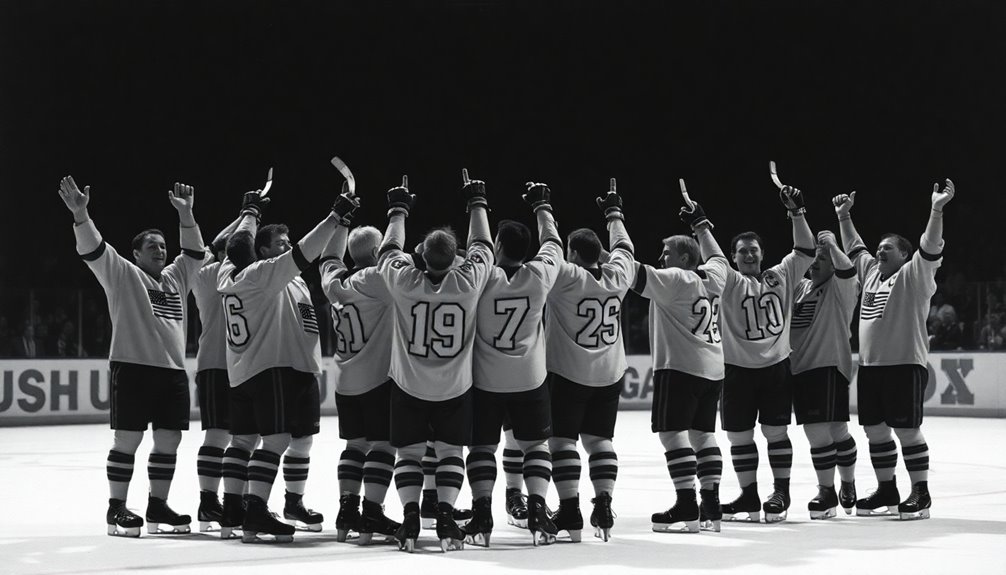
You've witnessed them, replayed them in your mind, and still get chills thinking about the most iconic moments in sports history. From Michael Jordan's "Flu Game" to Bobby Orr's Stanley Cup-winning goal, these moments etch themselves into our memories. Kirk Gibson's walk-off home run, the "Immaculate Reception," and Nadia Comăneci's perfect 10 are just a few that come to mind. Want to relive more of these unforgettable instances? Explore further to discover the thrill and drama that make sports so unforgettable.
Michael Jordan's "Flu Game" in the 1997 NBA Finals
As you watched Michael Jordan step onto the court for Game 5 of the 1997 NBA Finals, you couldn't help but wonder how he was even standing, let alone preparing to take on the Utah Jazz. Jordan's resilience was on full display as he battled a debilitating flu that left him weakened and drained. In spite of his condition, he still managed to score 38 points, including the game-winner, to lead the Chicago Bulls to a 90-88 victory. Jordan's Game 5 performance was a showcase of his unwavering determination and competitive spirit. His ability to persevere through adversity had a profound impact on the game, inspiring his teammates and demoralizing the Jazz. In that moment, Jordan's legend grew, and his "Flu Game" became an iconic moment in sports history.
Bobby Orr's Stanley Cup-Winning Goal in 1970
During the 1970 Stanley Cup Finals, you witnessed history being made as the Boston Bruins and St. Louis Blues were neck and neck, with the Bruins ultimately emerging victorious. In the deciding Game 4, you saw Bobby Orr score the Cup-winning goal in overtime, cementing his legacy as one of the greatest hockey players of all time. That moment is etched in the memories of hockey fans everywhere, symbolizing the Stanley Cup's significance as the supreme prize in professional hockey. As Orr flew through the air, his arms raised in triumph, you knew you were witnessing something special. The goal not only won the Bruins their first Cup in 29 years but likewise solidified Orr's place among the all-time greats. It's a moment that continues to inspire generations of hockey players and fans alike, and its impact on the sport is still felt today.
Kirk Gibson's Walk-Off Home Run in the 1988 World Series
One unforgettable October evening in 1988, you found yourself on the edge of your seat as the Los Angeles Dodgers faced off against the heavily favored Oakland Athletics in the World Series. The Dodgers were down 4-3 in the bottom of the ninth inning, with two outs and a runner on base. That's when Kirk Gibson, struggling with injuries, stepped up to the plate. His determination was palpable as he fouled off several pitches, working the count to 3-2. Then, in a moment that will be etched in sports history forever, Gibson hit a walk-off home run, securing the Dodgers' triumph.
| Moment | Impact |
|---|---|
| Gibson's walk-off home run | Dodgers win Game 1 |
| Two outs in the ninth inning | Dodgers' chances seem slim |
| Gibson's injuries | Doubts about his ability to perform |
| 3-2 count | Tension builds as the crowd holds its breath |
| Dodgers' underdog status | Victory against all odds |
The "Immaculate Reception" in the 1972 NFL Playoffs
You're about to relive one of the most unforgettable moments in NFL history – the "Immaculate Reception" during the 1972 playoffs. Franco Harris' incredible catch, which turned a seemingly lost cause into a game-winning touchdown, is still widely regarded as one of the greatest plays ever made. This tipped ball miracle will forever be etched in your memory as a game-changer that redefined the Steelers' season.
Franco Harris' Incredible Catch
Four seconds remained on the clock when Pittsburgh Steelers fullback Franco Harris made the impossible happen. You're about to relive a moment that would cement Harris' status as a sports legend. It's December 23, 1972, and the Steelers are facing the Oakland Raiders in the AFC Divisional Playoff game. Harris' incredible catch, known as the "Immaculate Reception," is a demonstration of his exceptional athleticism and instincts. With the Steelers trailing 7-6, Harris takes a deflected pass and turns it into a 60-yard touchdown, securing a 13-7 victory. This miraculous play not only propelled the Steelers to the AFC Championship but likewise solidified Harris' sports legacy as one of the greatest fullbacks in NFL history.
The Tipped Ball Miracle
As Franco Harris' incredible catch echoes through the ages, the specifics of that fateful play come into sharp focus. You're transported back to December 23, 1972, when the Pittsburgh Steelers faced the Oakland Raiders in the AFC Divisional Playoff. With 22 seconds remaining and the Steelers trailing 7-6, Terry Bradshaw's desperation pass was deflected by Raiders safety Jack Tatum. That's when Harris, a fullback, made the impossible happen. He scooped up the tipped ball, dodged multiple defenders, and sprinted 60 yards for the game-winning touchdown. This game-changing play, dubbed the "Immaculate Reception," cemented Harris' place in NFL lore and remains one of the most iconic moments in sports history.
One Playoff Game-Changer
Since the clock was ticking down, and desperation was setting in, Terry Bradshaw launched a Hail Mary pass into the fray, hoping against hope that someone, anyone, would come down with the ball. You're witnessing the 1972 NFL Playoffs, and this is the moment that will change the course of the game. Franco Harris, a Steelers fullback, makes an incredible leaping catch, turning a likely interception into a touchdown. This clutch performance is a demonstration of the Steelers' game strategy, which emphasizes adapting to high-pressure situations. Harris's "Immaculate Reception" will go down in history as one of the most iconic plays in sports, a showcase of the strength of quick thinking and athletic prowess under intense pressure.
Nadia Comăneci's Perfect 10 in the 1976 Olympics
You're watching the 1976 Olympic Games in Montreal, and the crowd is on the edge of their seats as Nadia Comăneci, a 14-year-old Romanian gymnast, steps onto the uneven bars. As she begins her routine, you sense something extraordinary is about to unfold. Nadia's athletic grace and precision mesmerize the audience, and the judges are equally impressed, awarding her a perfect score of 10. This momentous occasion marks the first time a perfect score has been achieved in Olympic history, revolutionizing the sport of gymnastics.
| Olympic Event | Score | Impact |
|---|---|---|
| Uneven Bars | 10.00 | First perfect score in Olympic history |
| Balance Beam | 9.95 | Solidified Nadia's lead in the all-around competition |
| Floor Exercise | 9.90 | Demonstrated Nadia's exceptional artistry and skill |
| All-Around | 79.275 | Earned Nadia the gold medal in the all-around competition |
| Legacy | – | Paved the way for future generations of female gymnasts |
Nadia's legacy extends far beyond this single moment, inspiring countless young gymnasts and cementing her place in Olympic history.
Jesse Owens' Four-Gold Medal Performance in the 1936 Olympics
Four days in August 1936 will forever be etched in the annals of sports history, as Jesse Owens, an African American track and field athlete, stunned the world by winning four gold medals at the Berlin Olympics. You witnessed a monumental moment in sports diplomacy, as Owens' athletic perseverance defied Olympic racism and promoted racial equality. His iconic performance had a profound global impact, cementing his legacy as a trailblazer.
Some key aspects of Owens' achievement include:
- Owens won four gold medals in the 100m, 200m, 4x100m relay, and long jump events
- He set multiple world records, which stood for decades
- His victory was a significant rebuke to Nazi Germany's ideology of Aryan supremacy
- Owens' achievement transcended sports, inspiring generations to fight for racial equality
- His legacy continues to inspire athletes and non-athletes alike, symbolizing the strength of sports to bring people together
The "Music City Miracle" in the 2000 NFL Playoffs
You're about to relive one of the most unforgettable plays in NFL history – the "Music City Miracle". This stunning trick play, dubbed "Home", was a masterclass in deception that will leave you wondering how it all came together. As you replay the lateral that changed the game, you'll appreciate the genius behind this iconic moment.
The Lateral That Changed
As the clock ticked down to zero in the 2000 NFL playoffs, the Tennessee Titans and Buffalo Bills were locked in a nerve-wracking 16-16 stalemate, with the winner advancing to the Divisional Round. You're on the edge of your seat, wondering what's going to happen next. That's when Titans fullback Lorenzo Neal takes the handoff and pitches it to tight end Frank Wycheck, who then laterals the ball to Kevin Dyson. The rest, as they say, is history.
Some key takeaways from this iconic play include:
- The Titans' game strategy was to use a trick play to catch the Bills off guard
- The lateral pass was a masterclass in execution, with all players involved making precise decisions
- The play required perfect timing and coordination to succeed
- It was a demonstration of the Titans' ability to think on their feet and adapt under pressure
- The "Music City Miracle" is still widely regarded as one of the most thrilling finishes in NFL playoff history
A Play Called "Home"
By the time the Titans huddled together to discuss their next move, the stakes were clear: a spot in the Divisional Round hung in the balance. You're standing on the sidelines, heart racing, as they devise a plan to overcome the 16-point deficit. The "Music City Miracle" is about to unfold.
| Player | Position | Action |
|---|---|---|
| Lorenzo Neal | Fullback | Takes the handoff |
| Frank Wycheck | Tight End | Lateral to |
| Kevin Dyson | Wide Receiver | Scores the touchdown |
As Dyson crosses the goal line, you feel the energy of the crowd. It's like a home run, a game-changer that propels the Titans to victory. The lateral is like a perfectly placed ball, sliding into home plate, securing the win. The "Music City Miracle" is etched in your memory forever.
A Moment of Deception
When the Titans' offense took the field with 16 seconds remaining, their desperation was palpable. You sensed they needed a miracle to overcome the 16-point deficit against the Buffalo Bills in the 2000 NFL Playoffs. What ensued was a masterclass in deception.
- The Titans' special teams unit lined up in a traditional kickoff formation, lulling the Bills into a false sense of security.
- Then, fullback Lorenzo Neal took a direct snap and handed the ball off to tight end Frank Wycheck.
- Wycheck tossed the ball to Kevin Dyson, who sprinted 75 yards to the end zone, securing a stunning 22-16 victory.
- The "Music City Miracle" was born, with the phantom foul on the Bills' defensive back adding to the controversy.
- This deceptive play will forever be etched in the annals of sports history as one of the most iconic moments of all time.
Muhammad Ali's "Rumble in the Jungle" Against George Foreman
Thirty-two years had passed since a heavyweight title fight had taken place in Africa, but on October 30, 1974, the continent witnessed one of the most epic battles in boxing history. You're about to relive the "Rumble in the Jungle," where Muhammad Ali took on George Foreman for the heavyweight title.
| Fighter | Strategy | Outcome |
|---|---|---|
| Muhammad Ali | Rope-a-dope, tire Foreman out | Won by KO in 8th round |
| George Foreman | Use brute strength to knock out Ali | Exhausted, lost by KO in 8th round |
| Muhammad Ali | Use quickness to evade Foreman's attacks | Successfully evaded Foreman's powerful blows |
| George Foreman | Try to intimidate Ali with aggressive style | Failed to intimidate, lost stamina |
| Muhammad Ali | Take advantage of Foreman's exhaustion | Landed decisive blows, won the fight |
Ali's strategy was to tire Foreman out by letting him throw powerful punches as Ali leaned against the ropes, covering himself from the blows. At the same time, Foreman's strength was his greatest asset, but it led to his downfall as he exhausted himself trying to knock Ali out.
Brandi Chastain's Penalty Kick in the 1999 Women's World Cup
Seventeen seconds into extra time, you're witnessing one of the most iconic moments in women's soccer history. Brandi Chastain's penalty kick in the 1999 Women's World Cup final against China is a defining moment that still resonates today. With the score tied at 0-0, Chastain's kick secured the win for the US, sparking an unforgettable celebration.
Some key aspects of this moment include:
- Chastain's celebration, ripping off her jersey and falling to her knees in pure elation
- The impact on Women's empowerment, inspiring a generation of young girls to take up the sport
- The sheer drama of the penalty shootout, with Chastain's kick being the decisive factor
- The significance of the US winning their first World Cup title since 1991
- The enduring legacy of Chastain's moment, cementing her status as a soccer legend
Frequently Asked Questions
What Is the Most Iconic Moment in Sports History of All Time?
Can you recall a moment in sports that left you speechless? You’re probably thinking of a few, but there’s one that stands out above the rest. In regard to the most iconic moment in sports history, you can’t ignore the greatest athletes who’ve made unforgettable plays. Michael Jordan’s “Flu Game” in the 1997 NBA Finals, Bobby Orr’s flying goal in 1970, or Ali’s “Rumble in the Jungle” – which one takes the top spot for you? Each of these moments not only showcased incredible athleticism but also highlighted the underlying narratives that define the most iconic sports rivalries. Whether it was the fierce competition between Jordan’s Bulls and the Jazz, Orr’s Bruins and the rival Canadiens, or Ali’s battles against Frazier, these rivalries have become woven into the fabric of sports history. It’s these high-stakes matchups that elevate individual performances into legendary status, leaving fans with memories that endure for decades.
How Do Iconic Sports Moments Impact Popular Culture?
You witness an iconic sports moment, and suddenly it's everywhere – on your social media feeds, in conversations with friends, and even in memes. That's due to the fact that these moments have a profound impact on popular culture. They gain cultural significance as they're replayed and rehashed across various media representation, from TV broadcasts to print ads. As you engage with these moments, you become part of a shared experience, connecting you to a broader community that transcends the sport itself.
Are Iconic Sports Moments Only Limited to Team Sports?
You might think iconic sports moments are exclusive to team sports, but that's not entirely true. Individual achievements can be just as iconic, especially when they involve legendary athletes pushing human limits. Think of Usain Bolt's world records or Serena Williams' Grand Slam dominance. These moments showcase exceptional talent and dedication, leaving a lasting impression on the sports world. They prove that iconic sports moments aren't limited to team sports, but can likewise be found in individual feats of greatness.
Do Iconic Sports Moments Only Happen in Major Championships?
You might think iconic moments only happen on the biggest stages, but that's not necessarily true. Although major championships can certainly produce unforgettable moments, you shouldn't discount local events or personal achievements. A record-breaking performance at a small-town track meet or a golfer's hole-in-one at a charity tournament can be just as iconic. It's about the emotional resonance and significance of the moment, not just the size of the crowd or the prize at stake.
Can Iconic Sports Moments Be Recreated or Replicated?
You've seen it time and again: 75% of sports fans remember iconic moments more than the actual game's outcome. Now, can these moments be recreated or replicated? The answer lies in overcoming replication challenges. It's not just about reenacting the physical action, but capturing the emotional authenticity that made the moment iconic in the first place. You can't manufacture the raw emotion, the surprise, or the historic significance. That's what makes true icons impossible to recreate, leaving their original moments forever etched in our collective memory.